StarrisedAds
Industry playbooks

How we optimize, vertical by vertical.

Same platform, different loop. What the model trains on, how audiences are built, and what tends to go wrong all change by category. These are the four we run most.

Shopping & E-commerce

Purchases · First-order ROAS

Catalog depth is a creative advantage, not a burden. The system generates product-led variations at scale and lets performance decide which SKUs, price points and offer framings get budget.

Creative

Automated product-feed variations across SKU, offer and seasonal angle — enough versions to run a real test on which products actually pull.

Audience

Category-intent modelling with separate paths for new-buyer acquisition and repeat-buyer reactivation, so the two do not cannibalise each other.

Optimization

Value-based bidding toward first-order ROAS and basket value rather than raw conversion count, so the model chases margin instead of volume.

Signals

Add-to-cart, checkout-start and purchase events fed back server-side, giving the optimizer a full funnel rather than a single endpoint.

Watch-out — Promo cycles reset the model

A big sale changes conversion behaviour enough that a model trained on baseline traffic stops being accurate. We plan learning windows around your promotional calendar so peak days run on a trained model — not a cold one that spends your budget learning during the exact week it matters most.

Gaming

Installs · Retention · Payer LTV

Install volume is the easy part and the wrong target. We optimize toward the players who stay and pay, which means training on events that happen days after the install.

Creative

High-volume playable and video variants iterated against IPM and downstream retention — not click-through rate, which rewards the wrong creative.

Audience

Genre-affinity and payer-propensity modelling, with whale-segment expansion once early monetization signals arrive.

Optimization

Multi-stage targets: install → D1 retention → first purchase → ROAS. Each stage promotes only what survives the previous one.

Signals

Tutorial completion, session depth and first-purchase events via your MMP, so quality is visible long before D30 ROAS is.

Watch-out — Soft launch and global launch are different models

A model trained on a small soft-launch geo does not transfer cleanly to a worldwide release — different competition, different CPMs, different player mix. We treat global launch as a fresh learning phase and say so up front, rather than carrying over a soft-launch model and calling it trained.

Finance & Fintech

KYC · Funded accounts

The cheapest registration is usually the worst one. Optimization has to run past the signup, or you buy volumes of users who will never complete verification.

Creative

Compliance-aware variants generated and pre-screened against market-specific rules before anything is eligible to serve.

Audience

Deep-funnel modelling toward KYC-complete and funded users, actively filtering the segments that produce registrations and nothing else.

Optimization

Post-signup events as the training target, with fraud and incentivized-traffic screening running inside the optimization loop.

Signals

Verification and first-deposit events returned server-side, since these are the only signals that correlate with real account value.

Watch-out — Deep-funnel events are sparse

Funded accounts happen at a fraction of the rate of registrations, so the model needs longer to accumulate enough of them — typically two to three weeks. We report on leading indicators through that window so you are not flying blind, and we do not quote you a stabilised CPA before the model has earned it.

Web3 & Trading Apps

Deposits · Active traders

Exchanges and trading apps carry a constraint the other verticals do not: where you are allowed to advertise changes by market, by platform and by month. Eligibility screening comes before optimization, not after.

Market eligibility

Geo and platform screening against current advertising restrictions, applied at the campaign level so ineligible inventory is never bought in the first place.

Creative

Risk-disclosure and claim rules enforced per market before a variant becomes eligible — no performance claims where they are not permitted.

Audience

Trading-intent modelling toward deposit and sustained-activity signals, with hard filtering against incentivized and bot-driven traffic.

Optimization

First deposit and 30-day activity as training targets, so the system optimizes for traders who stay rather than accounts that open and go quiet.

Watch-out — Regulation moves faster than campaigns

Advertising eligibility for crypto and CFD products shifts by jurisdiction with little notice. We keep market rules as campaign-level constraints that can be updated centrally, so a rule change pauses ineligible delivery rather than surfacing weeks later in a compliance review.

Applies to all four

Every vertical starts with a learning phase.

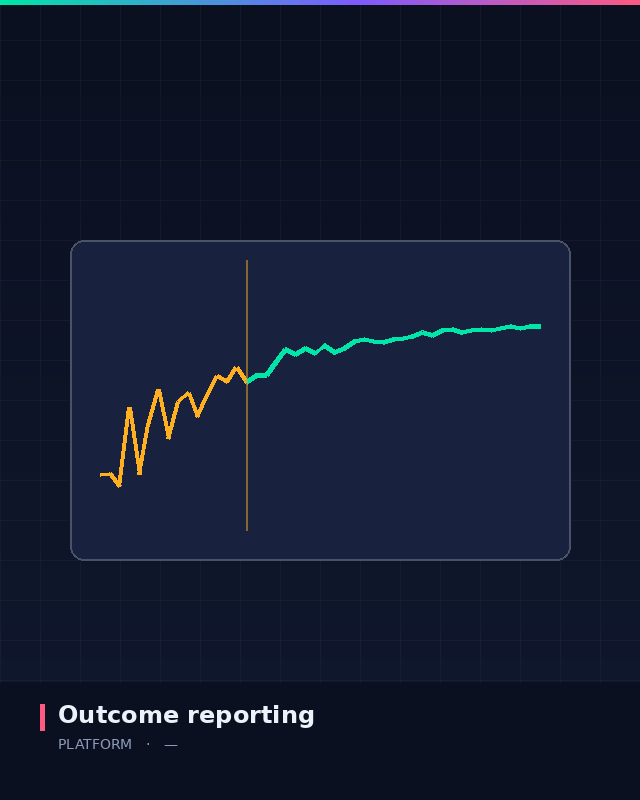
The model needs real outcome data before it can optimize toward it. We tell you what to expect, what we are watching during the window, and when performance should stabilise — instead of promising day-one results we cannot defend. How long the window runs depends on how deep in the funnel your objective sits.

Creative formats

What the system produces.

Placement formats across mobile and CTV. Every one of these can be generated as a variant set rather than a single execution.

App install creative format
App installMobile
E-commerce sale creative format
Catalog & offerMobile
Lead generation creative format
Lead captureMobile
Brand lift creative format
Brand videoMobile
Retargeting creative format
RetargetingMobile
Seasonal promotion creative format
PlayableMobile
Connected TV streaming inventory
Streaming spotCTV
Reporting dashboard
Outcome reportingPlatform

Which of these is your problem?

Bring us the objective and the market. We will tell you which loop applies, how long the learning phase should take, and where we think the risk sits.